How to choose a perfume to find your signature scent
Finding your true fragrance, the one that seems to have been created just for you, is much more than a matter of smelling good. It's an intimate quest, a way of presenting yourself to the world without uttering a single word. But let's be honest, it's also a real headache. We've all made the mistake of an impulsive purchase, seduced by a top note in a perfumery, only to leave the bottle gathering dust.
The idea is to transform this sometimes intimidating search into a genuine exploration. It's a bit like learning a new language: you need to understand the basics to be able to express yourself fully.

Why is it so personal?
A perfume is a signature. It evokes a mood, a memory, a facet of your personality. It can give you confidence before an important meeting, envelop you in softness on a rainy day, or simply make you feel... yourself.
In France, perfume is part of our DNA. It's no coincidence that houses like LVMH or Chanel are global benchmarks. It's a daily ritual for many, as evidenced by the fact that 55% of Europeans wear perfume every day. This culture of excellence makes the search exciting, but also a little more demanding.
The goal is not to follow the latest trend, but to find the fragrance that resonates with who you are. It's about finding the perfume that completes your story.
Explore without commitment
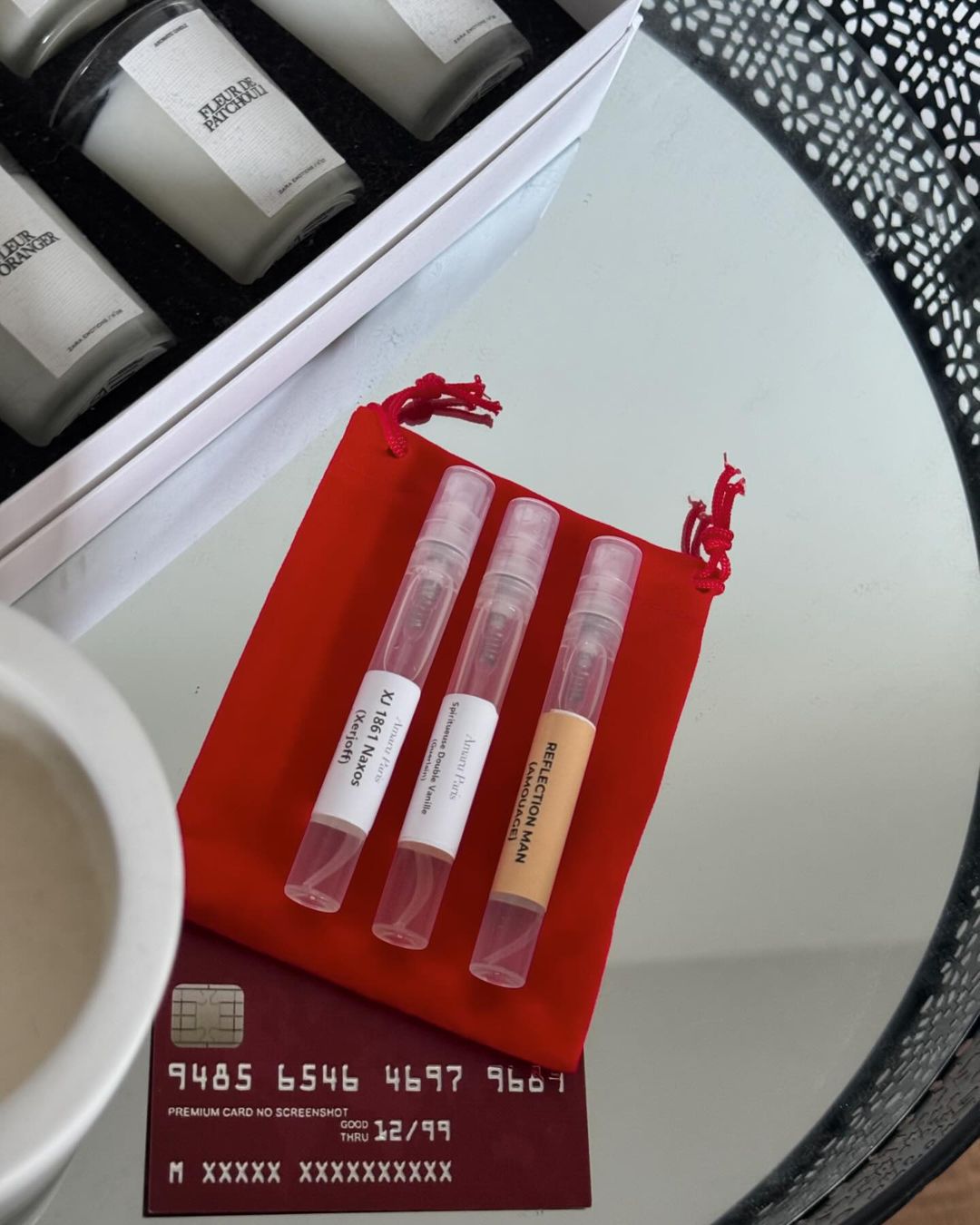
The good news? Gone are the days when you had to invest in a 100ml bottle to know if you really liked a perfume. Today, you can test, explore, and take your time. This is exactly what we offer at AmaruParis. Imagine receiving samples of niche or designer perfumes and wearing them in your daily life.
It's the best way to truly discover a fragrance.
- See how it evolves on your skin. A perfume changes over hours, from the fresh top notes to the deeper base notes that linger.
- Test its longevity. Does it last a whole workday or fade after your morning coffee?
- Build your olfactory "wardrobe." You don't wear the same perfume for a summer wedding as for a cozy winter evening, do you?
Thanks to samples, the pressure disappears. The search becomes a game, a discovery. It's the smartest way to find a perfume that will truly accompany you, without any regrets.
To begin your exploration, why not take a look at our selection of the 10 best luxury French perfumes for men and women? You might find your next favorite there.
Decoding the structure of a perfume
Choosing your perfume is much more than a simple matter of first impression. Imagine: you wouldn't judge a book by its cover alone, would you? It's the same for a fragrance. Each perfume is a living construction, an olfactory architecture designed to transform on your skin. This is called the olfactory pyramid.
Understanding this three-act structure is key to truly knowing how to choose your perfume. It allows you to see beyond the first few seconds and anticipate the journey the fragrance will take you on.
The first impression: top notes
As soon as you spray it, these are what you smell. Top notes are there to capture your attention, to create a lively and memorable opening. Think of an explosion of freshness, often from very light and volatile ingredients.
- Typical ingredients: Citrus fruits like bergamot or lemon, aromatic herbs like lavender, green notes…
- Their role: To create the first contact and pique your curiosity.
- Their duration: They are very ephemeral and disappear in 15 to 30 minutes.
This is the mistake we all make at first: falling in love with these notes and buying the perfume impulsively. But this is just the prologue. A perfume like Jo Malone's Oud & Bergamot is a perfect example, with its dazzling citrus opening that fades to reveal a much deeper richness.
The heart of the matter: middle notes
Once the initial freshness evaporates, the soul of the perfume is revealed. Middle notes are the main theme, the true character of the fragrance. More rounded and complex, they define whether a perfume is more floral, spicy, or fruity.
They appear after a few minutes and can last several hours. This is where the perfume asserts its personality. Take an iconic example like Maison Francis Kurkdjian's Baccarat Rouge 540: its heart of jasmine and saffron creates that instantly recognizable signature, long after the top notes have disappeared.
A perfume is judged above all by its heart. It is the melody that remains when the introduction is over. This is the phase that must truly speak to you and match you.
The lasting imprint: base notes
Finally, the base notes make their entrance. They are the foundation of the composition, those that anchor the perfume and create that memorable sillage you leave behind.
Composed of heavy molecules, they evaporate very slowly. They can last on the skin for more than 6 hours, and sometimes even until the next day on clothing.
- Typical ingredients: Woods (cedar, sandalwood), resins (frankincense), musks, amber, vanilla.
- Their role: To bring depth, warmth and, above all, longevity.
- Their duration: From 6 hours to over 24 hours.
Base notes are the memory of the perfume. In Tom Ford's Tobacco Vanille, creamy vanilla and tobacco form an opulent base that envelops the skin in sensual warmth for hours.
Understanding this dynamic is essential. A perfume is not a fixed scent; it's a story that unfolds over hours. To learn more, you can consult our guide on the secrets of olfactory notes in French perfumes. By mastering the olfactory pyramid, you will no longer choose a perfume for the present moment, but for the story it will tell about you throughout the day.
Mastering the art of testing to finally find the right one
The most classic mistake when trying to choose your perfume? Relying on a simple paper strip hastily smelled in a store. This is the best way to regret your purchase. A perfume is an alchemy that only comes alive when it touches your skin. Judging it on a piece of cardboard is like judging a dish from a mere photo.
This step is undoubtedly the most crucial in your quest. It's here that you'll know if a fragrance is a simple olfactory crush or the beginning of a true story. And for that, there's only one reliable method: a prolonged test, on your skin.
Your skin is the only judge
Forget the paper blotter. At best, it will give you a fleeting and often misleading glimpse of the top notes. The real magic happens when the perfume molecules meet the unique warmth and pH of your skin. It's this chemical reaction that makes a perfume your perfume.
For a meaningful test, spray the sample on your pulse points. These are the areas where blood flows and generates heat, such as the inside of your wrists, the crooks of your elbows, or behind your ears.
And above all, the golden rule: never rub your wrists! This gesture, seen everywhere, is anathema to connoisseurs. It breaks down the most delicate molecules and completely distorts the evolution of the perfume. Just let it dry and tell its story.
Allow the perfume time to reveal itself
A perfume is a living composition, a story that unfolds in three acts. To truly understand it, you must give it time to express itself. Take a sample, a little patience, and follow its evolution.
- After 5 minutes: The top notes, vibrant and volatile, are still there but starting to soften. This is your first real contact with the juice on your skin.
- After 1 hour: The heart of the perfume is finally revealed. This is the moment of truth. Does this floral bouquet, this spicy base, or this fruity facet truly appeal to you?
- After 4 hours (and more): It's time for the base notes. This is the sillage that will remain on you and your clothes for hours. Is it comforting? Elegant? Does it match the impression you want to leave?
This infographic clearly shows how the notes follow each other, from the first impression to the final signature.

It's immediately clear why an impulsive purchase based on the first 10 seconds is such a bad idea. You only discover a tiny part of the olfactory pyramid.
The sample: your nose's best ally
How do you live with a perfume for several hours, or even a whole day, without investing in a full bottle? The answer is simple: samples (or decants). It's by far the smartest and most economical solution for real-world testing.
AmaruParis decants are designed for this. They give you the freedom to wear a fragrance to the office, out at night, or even during your workout. It's the only way to check its longevity, how it evolves on you, and, most importantly, if you still love it after 8 hours.
A perfume must be experienced, not just smelled. A sample gives you the freedom to go out with a fragrance before committing to it.
This long-term test is essential, especially with richer concentrations. The Eau de Parfum (EDP) market is expected to account for 56.22% of sales by 2036, as we are all looking for lasting scents. Even if 61.45% of purchases are still made in-store, a quick test does not allow you to verify if an EDP's longevity lives up to its promises on your skin.
To delve deeper into the subject, take a look at our article on the benefits of buying perfume samples online.
How to avoid olfactory saturation?
After smelling so much, your nose eventually gets saturated. This is called olfactory fatigue. To "reset" your sensors between two perfumes, the trick is simple: smell a neutral and familiar scent. The smell of your own skin, in the crook of your elbow for example, is perfect for this. Forget the myth of coffee beans; they only add another strong odor to the equation.
By mastering this art of testing, you put all the chances on your side to find a perfume that not only smells good, but truly becomes a part of you.
Perfume, a story of skin and moments
Perfume is never an exact science. It's a living alchemy. The same fragrance can reveal itself completely differently on you and on another person. Your skin, the weather, your mood, and even your daily agenda... everything influences the final result.
To refine your quest for a signature scent, you must go beyond notes and families. It is essential to understand how your own skin interacts with a fragrance and in what context you will wear it.
The alchemy between perfume and your skin
Have you ever had the impression that a perfume evaporates on you in an hour, while it lasts all day on a friend? That's not just an idea. It's your skin chemistry speaking.
- Dry skin: Lacks lipids to "grip" the perfume molecules. As a result, the fragrance evaporates faster, especially light top notes like citrus. Longevity is often reduced.
- Normal to combination skin: The perfect balance. The perfume develops harmoniously, respecting its olfactory pyramid, and longevity is generally good.
- Oily skin: Sebum tends to magnify and warm the notes, which can sometimes transform them, but almost always ensures exceptional longevity.
If your skin tends to "drink" perfumes, opt for more intense concentrations like an Eau de Parfum (EDP) or an extrait. Their base notes (woody, amber, vanilla) are heavier and will cling much better. A little tip: hydrate your skin well before perfuming yourself. A neutral cream will work wonders for longevity!
Creating your olfactory wardrobe through the seasons
Wearing a powerful oriental perfume in the middle of a heatwave? That's the best way to feel suffocated, and your surroundings with you. Heat amplifies the diffusion of a perfume, that's a basic rule.
Adapting your perfume to the season is not a strict rule, but rather a way to play with atmospheres and feel in perfect harmony with the moment.
In spring and summer: freshness and lightness When the thermometer rises, we want freshness. Light compositions are your best allies, as the warmth of the skin will naturally reveal them without making them overpowering.
- Ideal families: Citrus (think grapefruit, bergamot), fresh florals (lily of the valley, peony), aquatic or green notes.
- A concrete example: For a summer day on a terrace, a sparkling eau de Cologne or a floral-fruity like Giorgio Armani's Acqua di Gioia is just perfect.
In autumn and winter: make way for warmth and comfort Cold, on the contrary, tends to dull perfumes. So it's time to bring out the heavy artillery! We turn to enveloping, warm and comforting fragrances, like a good cashmere sweater.
- Ideal families: Woody (sandalwood, cedar), oriental (amber, vanilla), spicy (cinnamon, cardamom) and gourmand (cocoa, coffee, caramel).
- A concrete example: For a winter evening, a scent like Kilian's Angels' Share, with its notes of cognac and cinnamon, is simply unforgettable.
This seasonality is a well-established reflex among perfume lovers. The women's segment, which is expected to account for over 53% of the global perfume market by 2026, is particularly fond of long-lasting fragrances adapted to every moment. In a constantly evolving French perfume and cosmetics market, knowing how to choose is a true art of living.
A perfume for every occasion
You don't dress the same way for work as you do for a wedding. It's the exact same for perfume. The context dictates the choice.
At the office: subtlety above all The idea is to enjoy yourself without imposing your scent on the entire open-plan office. An overly heavy perfume can quickly become a nuisance for colleagues.
- The right choice: Opt for discreet perfumes, also called "skin scents." Musky notes, delicate florals, or light woody scents are perfect. A fragrance like Maison Margiela's Lazy Sunday Morning is an excellent example.
For a romantic date: the game of seduction Here, you can afford a little more daring. Choose a fragrance that tells something about you, with a hint of sensuality and mystery.
- The right choice: Oriental, gourmand notes or opulent white flowers (jasmine, tuberose) are your allies. A classic like Dior's Hypnotic Poison always makes an impression.
For relaxing moments: pure comfort On weekends, on vacation, or simply to stay at home, perfume becomes a selfish pleasure, a bubble of well-being.
- The right choice: Fresh and clean notes, aromatic (lavender) or soft vanilla create a comforting sensation. Yves Saint Laurent's Libre, with its lavender and orange blossom duo, is a magnificent choice for these moments.
Building a true "olfactory wardrobe" can quickly become expensive. This is precisely where AmaruParis's sample service comes into its own. It allows you to test and own several fragrances for all occasions, without having to invest in large bottles. The freedom to always be perfectly perfumed, whatever the context.
Become the master of your scent trail thanks to layering
So, you've found one or more fragrances that speak to you. Does the quest end there? For true enthusiasts, it's quite the opposite: the adventure has only just begun. Taming your sillage means learning to sculpt it, to make it unique. It's your signature.

Even before talking about personalization, you need to make sure your perfume lasts. Nothing is more frustrating than a scent trail that disappears in a few hours. The number one secret is hydration. Nourished skin is a canvas that holds perfume molecules better. Make it a habit to apply a neutral, unscented body cream before perfuming yourself.
Also, consider your clothes. Textile fibers are true perfume sponges, much more so than skin. A light spray on a scarf, a jacket lining, or a hem can extend your scent trail for days. One tip: always test on a hidden part of the fabric to avoid unpleasant surprises, especially with silk.
The art of layering
Layering is the technique that transforms a simple perfume wearer into a creator. It's the art of combining several fragrances to compose a unique scent trail that's all your own, an olfactory melody that no one else will wear. This is where the game truly gets interesting.
The goal is not to create a cacophony by mixing everything and anything. It's more about a dialogue between perfumes. This way, you can add depth to a somewhat linear fragrance, temper a too-powerful note, or simply invent a new story.
A few simple principles will guide you to get started.
First, always apply the most opulent perfume first. Heavy and complex fragrances, such as orientals, woody notes, or leathers, form a solid and lasting base.
Then, add the lightest touch on top. More airy and volatile notes, typical of citrus or delicate florals, can then fully express themselves without being overwhelmed.
Finally, avoid spraying in the same place. Instead, apply the perfumes to nearby areas: the most intense on the wrists, for example, and the freshest behind the ears or on the neck. Your scent trail will gain complexity and evolve with your movements.
Which combinations for successful layering?
Experimentation is king, but some avenues are sure bets. The secret is always balance.
- Playing on harmony: The simplest way to start is to combine two perfumes that share a note. Do you love vanilla? Layer two creations that feature it differently to explore all its facets.
- Daring with contrast: The most memorable combinations often arise from the meeting of opposites. Awaken a spicy oriental perfume with a bright citrus touch. Soften a somewhat austere woody scent with the caress of a powdery floral.
Layering is a creative dialogue you initiate with your perfumes. It's a way to tell a new story with scents you already cherish.
Here are some ideas for pairings that work wonderfully, drawing from renowned niche creations:
- Sensual and luminous trail: Combine the amber warmth of Maison Francis Kurkdjian's Grand Soir with the floral opulence of Frédéric Malle's Carnal Flower. The amber provides the base, the tuberose provides the radiance.
- Textured woody freshness: Marry a smoky woody scent like Tom Ford's Oud Wood with a vibrant citrus like Byredo's Bal d'Afrique. The light of bergamot and vetiver will illuminate the depths of oud wood.
- Sophisticated gourmandise: Layer the spicy vanilla of Nishane's Ani with the distinctive leather of Tom Ford's Ombré Leather. The vanilla loses its sugary innocence to gain in mystery and character.
To embark on these experiments without breaking the bank, AmaruParis's sample service is the ideal tool. It gives you access to decants from mythical houses like Amouage or Xerjoff. It's the best way to test, compare, and compose the olfactory signature that truly suits you.
Your olfactory journey has only just begun
There you have it, you now have a much better idea of how to navigate the vast world of perfumes. Far from being a simple matter of fashion, choosing a perfume is a deeply personal endeavor. It's about learning to recognize the olfactory families that suit you, mastering the art of testing on your skin, and finding the scent trail that matches your lifestyle.
The real secret is not to rush. Let the fragrance evolve. A perfume is a story that unfolds over several hours, not in a few minutes on a paper strip.
The ideal perfume is not the one you find in five minutes in a store, but the one you discover and learn to love over days. It should evolve with you, highlight a facet of your personality, and make you feel unique.
Don't be afraid to step out of your comfort zone and experiment. Thanks to sampling services like the one we offer at AmaruParis, exploring the creations of the biggest luxury houses becomes child's play. It's the perfect opportunity to test, compare, and build your perfume collection, step by step.
Whether you're looking for a signature for everyday wear, a fragrance for a special occasion, or simply the joy of discovery, the perfect perfume exists and it's waiting for you. The exploration can begin.
Your last questions about choosing a perfume
Even after exploring notes and families, a few questions often linger in your mind. That's perfectly normal! The world of perfume is rich and complex. Here are some answers to help you see more clearly and confidently find that rare gem.
How long does it really take to "smell" a perfume?
Give it time to live on your skin. Ideally, a full day. The top notes, which you smell on the first spray, are the most volatile and fade in less than 30 minutes.
It's after this initial contact that the heart of the perfume truly reveals itself. It will develop for several hours. But the real test is to wait 4 to 6 hours to discover the base notes, those that create the sillage and define the lasting personality of the fragrance. The best advice? Test a sample in the morning and see how you feel about it by evening.
Are online reviews reliable?
Yes and no. Reviews are a goldmine for discovering new fragrances or getting a general idea of a perfume's style. You can gather information about its longevity, sillage, or the impression it leaves.
But you must never forget that skin chemistry is unique. A perfume that smells divine on someone else might not suit you at all.
Consider reviews as a source of inspiration, a first screening step. But the only truth that matters is that of your skin. Testing is essential.
Niche or designer perfume: how to choose?
This is a common question, and the distinction is quite simple once you know it:
- Designer perfumes (Dior, Chanel, Yves Saint Laurent): Created by major fashion houses, they are often designed to appeal to the widest audience and capture the zeitgeist.
- Niche perfumes (Amouage, Byredo, Xerjoff): These come from houses dedicated exclusively to perfume. Creativity is freer, compositions are bolder, and ingredients are sometimes rarer.
If the world of niche perfumes intrigues you, samples are the perfect way to explore it without committing to a substantial budget.
How do I know if I'm wearing too much perfume?
The golden rule is subtlety. Your perfume should be a personal aura, perceptible at arm's length, not across the room. If you receive compliments on your perfume while someone is still far from you, it might be a sign that it's a bit too strong, especially in a professional setting.
Our tip: always start with one or two sprays when trying a new perfume. Then, ask a trusted friend for their opinion on whether the sillage is just right, and adjust if necessary.
Ready to put all this into practice? Discover hundreds of authentic fragrances and find your olfactory signature with complete peace of mind with AmaruParis samples. The exploration begins here: https://amaruparis.com
Written with Outrank app