

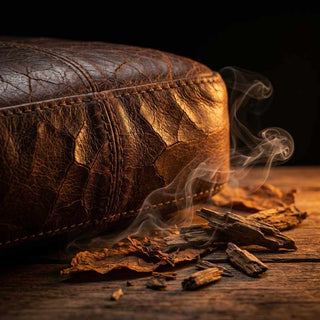
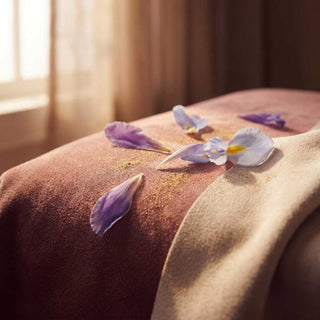










A saddlery in the early morning. A leather goods workshop. The interior of a luxury car. Some scents leave a lasting impression on memory. Leather fragrances draw on these to create perfumes with a strong personality, worn by both women and men. On Amaru Paris, explore this olfactory family with samples from 1 ml to 50 ml.
What is a leather fragrance?
The leather family is one of the oldest and most respected in perfumery. Its origins date back to the perfumers of Grasse in the 17th century, who created scented leather gloves to mask the smell of tanneries. It is from this tradition that the leather accord in perfumery was born: an olfactory recreation that evokes the material without ever literally imitating it.
In the 20th century, the house of Caron marked a decisive turning point with Cuir de Russie in 1924, followed by Chanel with its own version also in 1924, two compositions that laid the foundations of modern leather in perfumery. Later, perfumers like Ernest Beaux or Edmond Roudnitska refined this accord, giving it at times a floral, at times a smoky or animal dimension.
Technically, leather in perfumery is obtained using materials such as birch, isobutyl quinoline, cistus, or certain aldehydes that reproduce the smoky, tanned, or fatty facets of worked leather. Depending on the associations chosen by the perfumer, the result can be dry and mineral, soft and powdery, smoky and animal, or even floral and sensual.
For a woman, a leather fragrance brings natural self-assurance and an assertive femininity, far from sweet and sugary clichés; it is a strong choice that leaves an impression. For a man, it enhances woody or aromatic compositions with a noble depth and an immediate presence.
How to choose your leather fragrance sample?
Leather is a note that can be surprising at first contact, especially if you are not used to it. This is precisely why the sample is essential: it allows you to experience the fragrance over several hours, to get acquainted with its facets, and to see how it blends with your skin.
If you are new to leather fragrances, start with leathery-floral or leathery-fruity compositions, which are more accessible and less intense. If you are looking for something more assertive, smoky or animalic leathers, often associated with oud, vetiver, or resin, will offer the depth and character you are looking for.
Keep in mind that leather reveals itself over time: the first few minutes can be unsettling, but it is often on the skin, after an hour of wear, that a leather fragrance reveals its full beauty.
Hesitating? Our quiz guides you in a few questions to the leather fragrance that's right for you.
The best leather fragrances
Cuir Beluga, Guerlain
Guerlain, a house founded in 1828 and guardian of unique olfactory expertise, delivers with Cuir Beluga an interpretation of leather of rare delicacy. Here, there is no brutality or excess: leather expresses itself in its most civilized version, enveloped in heliotrope notes, sweet vanilla, and a woody base of great serenity. It is a lounge leather rather than a saddlery leather, refined, almost precious, suitable for both women and men, and serves as an ideal introduction for those who wish to discover this olfactory family without intimidation.
Cherry Smoke, Tom Ford
With Cherry Smoke, Tom Ford plays the card of absolute contrast: juicy, almost candied black cherry collides with a smoky leather accord of unsettling intensity. The tension between the sweetness of the fruit and the bite of the leather creates a mixed composition of rare sophistication, somewhere between temptation and transgression. Notes of guaiac wood and patchouli anchor the fragrance in an assumed animal depth. It is an evening fragrance, with a strong character, for those who do not seek to go unnoticed.
African Leather, Memo Paris
Memo Paris is a house that builds its fragrances like travel journals, and African Leather is no exception to this philosophy. Inspired by the vast spaces of the African continent, this mixed composition combines a dry, dusty leather with notes of incense, sandalwood, and warm spices for a strikingly unique result. One perceives the warmth of a savanna at dusk, the noble ruggedness of untreated leather. A fragrance for adventurous spirits who seek something more than a simple accessory in perfumery.
Dans la Peau, Louis Vuitton
Louis Vuitton, a house whose very DNA is leather, could not fail to have its benchmark leather fragrance. Dans la Peau, signed by in-house perfumer Jacques Cavallier-Belletrud, is a declaration of love for the material. The leather accord is treated with almost surgical precision: neither smoky nor animalic, but with a clean and sensual softness that directly evokes the house's leather goods workshops. Notes of iris and white musk surround it with a luminous femininity. A feminine fragrance of absolute coherence, where the perfume and the identity of the house are one.
When to wear a leather fragrance?
Leather fragrance has long been associated with special occasions and formal wear, and it still excels in these. But contemporary perfumery has considerably broadened its scope of application.
In autumn and winter, leather fragrances find their favorite ground. The freshness of the air amplifies their natural warmth, and their depth contrasts admirably with the coats and thick materials of the cold season.
In the evening, a smoky or animalic leather asserts an immediate presence and leaves a memorable trail. It is the choice of those who fully embrace their olfactory personality.
For everyday wear, softer, floral, powdery, or slightly fruity leathers integrate perfectly with professional or casual attire. They add a strong signature without ever becoming overpowering.
For a man, a woody or smoky leather fragrance naturally complements a sober and elegant style, whether it's a suit or a more casual look. For a woman, it brings an unexpected and assertive dimension to any outfit; it is often the perfume that others notice and want to know the name of.